

Proposal description
Overview
We propose the development of dash-go, a new, independent full-node client for the Dash network, implemented from the ground up in Go.
The primary objective of dash-go is to strengthen Dash’s long-term network resilience by reducing reliance on a single node implementation, while also improving operator experience, observability, and developer reuse.
This proposal focuses on building a production-grade alternative client that can run alongside Dash Core.
Why do we need another node client?
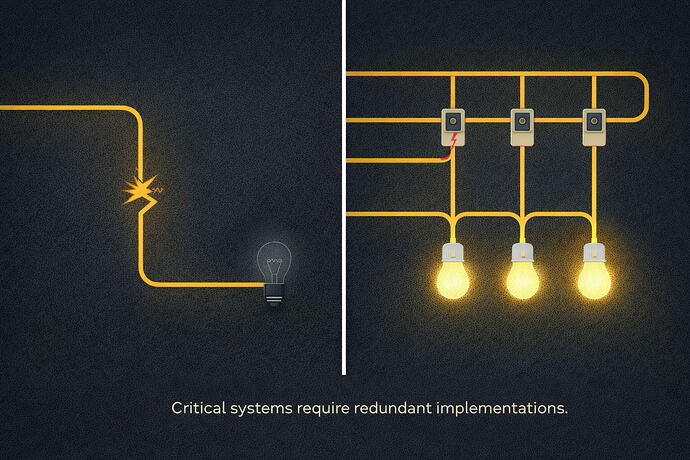
Today, Dash relies on a single full-node implementation. While mature and battle-tested, a single-client architecture introduces systemic risk:
Proposal
dash-go is an independent, alternative Dash full-node client written in Go, designed with a focus on the following pillars:
Scope of Work
Read the full Technical Specification:
[color=#333333]https://docs.google.com/document/u/1/d/e/2PACX-1vTsHCNuwF0NodA823Ujprij4XOUh5nVWu1Gjh4GWb2DfBZDKmfU5UL7cO2NEFPjDqgK19lxe-y9ATSS/pub
[/color]
To minimize risk and establish trust within the Dash community, the dash-go full-node specification is deliberately structured into two phases with multiple milestones.
Phase 1, Milestone 1:State and Block Import (4 Months)
Milestone 1 establishes the core consensus foundation of dash-go. The objective of this milestone is to enable deterministic block processing from genesis while maintaining byte-for-byte compatibility with Dash Core where consensus rules apply.
4. Cryptography Integration and Verification: This includes integrating the official Dash BLS signatures Go bindings and validating the native Go X11 implementation against historical Dash block headers using an exhaustive test harness to ensure bit-for-bit identical Proof-of-Work validation compared to dashd.
Team and Budget
Chainscore Labs is a Web3 Research and Development firm founded in 2021. We specialize in delivering core, high-performance infrastructure for leading blockchain ecosystems. We have deep expertise in protocol engineering, cryptography, DeFi, and full-stack protocol development. We have worked with several L1s to develop node clients. More details in proposal spec. Website
To deliver Milestone 1, we are requesting a budget of $320,000, equivalent to $80,000 (~909 DASH) per month over 4 months. This funding will cover engineering costs for 6 FTE protocol engineers and a technical lead.
Closing
Dash has always prioritized reliability and real-world usability. Investing in an independent node client is a direct investment in the network’s long-term health.
We respectfully ask for your vote in support of dash-go. Thank you for your consideration.
We propose the development of dash-go, a new, independent full-node client for the Dash network, implemented from the ground up in Go.
The primary objective of dash-go is to strengthen Dash’s long-term network resilience by reducing reliance on a single node implementation, while also improving operator experience, observability, and developer reuse.
This proposal focuses on building a production-grade alternative client that can run alongside Dash Core.
Why do we need another node client?
Today, Dash relies on a single full-node implementation. While mature and battle-tested, a single-client architecture introduces systemic risk:
- A critical bug, consensus issue, or security flaw affects the entire network simultaneously
- Network upgrades and experimentation are constrained by one codebase
- Node operators lack modern, built-in observability and deployment tooling
- Developers cannot easily reuse Dash internals without running a full node
Proposal
dash-go is an independent, alternative Dash full-node client written in Go, designed with a focus on the following pillars:
- Network Resilience: dash-go provides a second, independently implemented client that reduces single-client risk. In the event of a critical issue in the primary client, the network retains an alternative implementation capable of maintaining continuity.
- Modern Node Monitoring and Observability: dash-go includes native support for modern monitoring stacks such as Prometheus and Grafana. Masternode operators gain real-time visibility into node health, peer connectivity, sync status, and performance metrics without relying on external tooling.
- Modular and Extensible Architecture: The client is built as a set of decoupled libraries. This enables developers to reuse Dash components such as networking, consensus logic, or indexing in other applications without operating a full node.
- Easier Operator Onboarding: dash-go is designed for fast, reliable deployment through:
- One-click cloud images for AWS, GCP, and Azure
- Infrastructure-as-Code templates using Terraform and Helm
- Secure defaults, automated bootstrap, and preconfigured monitoring
Scope of Work
Read the full Technical Specification:
[color=#333333]https://docs.google.com/document/u/1/d/e/2PACX-1vTsHCNuwF0NodA823Ujprij4XOUh5nVWu1Gjh4GWb2DfBZDKmfU5UL7cO2NEFPjDqgK19lxe-y9ATSS/pub
[/color]
To minimize risk and establish trust within the Dash community, the dash-go full-node specification is deliberately structured into two phases with multiple milestones.
- Phase 1 consists of four milestones and focuses exclusively on delivering a fully independent consensus node client.
- Phase 2 builds on this foundation by introducing Dash-specific services.
Phase 1, Milestone 1:State and Block Import (4 Months)
Milestone 1 establishes the core consensus foundation of dash-go. The objective of this milestone is to enable deterministic block processing from genesis while maintaining byte-for-byte compatibility with Dash Core where consensus rules apply.
- Core Types and Consensus Serialization: All core Dash data structures will be defined as native Go structs, including Block, BlockHeader, and standard Transaction types. Consensus-critical serialization and deserialization routines (MarshalBinary / UnmarshalBinary) will be implemented to exactly match dashd’s little-endian byte-level encodings. Data structures for Phase 2 Special Transactions defined in DIP-0002 will also be included to ensure correct parsing, even though their validation logic is intentionally deferred.
- Transparent State Management (UTXO Set): The UtxoDB service will be implemented to manage the transparent Unspent Transaction Output (UTXO) set. This service will be built on a Go-native embedded key-value store such as PebbleDB and will define a deterministic database schema mapping transaction outputs to amounts and scriptPubKeys. Core state transition logic will handle verification, consumption, and creation of UTXOs during block processing.
- Block Import and Chain Validation: A dedicated Chain Service will be developed to handle block import and validation. For Phase 1, this includes:
- Validating X11 Proof-of-Work on block headers
- Verifying all transparent transactions against the UTXO set
- Enforcing the 100-block coinbase maturity rule
- Atomically applying block state changes to the UtxoDB
4. Cryptography Integration and Verification: This includes integrating the official Dash BLS signatures Go bindings and validating the native Go X11 implementation against historical Dash block headers using an exhaustive test harness to ensure bit-for-bit identical Proof-of-Work validation compared to dashd.
Team and Budget
Chainscore Labs is a Web3 Research and Development firm founded in 2021. We specialize in delivering core, high-performance infrastructure for leading blockchain ecosystems. We have deep expertise in protocol engineering, cryptography, DeFi, and full-stack protocol development. We have worked with several L1s to develop node clients. More details in proposal spec. Website
To deliver Milestone 1, we are requesting a budget of $320,000, equivalent to $80,000 (~909 DASH) per month over 4 months. This funding will cover engineering costs for 6 FTE protocol engineers and a technical lead.
Closing
Dash has always prioritized reliability and real-world usability. Investing in an independent node client is a direct investment in the network’s long-term health.
We respectfully ask for your vote in support of dash-go. Thank you for your consideration.
Show full description ...
Discussion: Should we fund this proposal?
Submit comment

{
"total": 2918,
"enabled": 1927,
"detailed": {
"regular": {
"total": 2571,
"enabled": 1594
},
"evo": {
"total": 347,
"enabled": 333
}
}
}
MNOs should take a moment to read through the full discussion on this proposal and then consider the two vulnerabilities that were just discovered at the eleventh hour. Right now, the network is in a race against time to patch holes that could trigger yet another chain halt:
https://www.dash.org/forum/threads/dash-platform-version-3-0-0-released-emergency-update-to-3-0-1.69083/post-255419
Sam previously argued that raising the treasury from 10% to 20% would help fund additional projects. But given today’s events, can anyone think of a project more worthy than strengthening the core infrastructure itself?
Fragility through monoculture or resilience through diversity.
Take your pick.
So, once again, piss off with your framed bullshit, GMD and have a nice day!
Your explanation about AI tools actually reinforces the point. If the codebase is now so complex that vulnerability detection depends on the behavior of evolving AI models, that increases uncertainty on both sides; development and exploit discovery. It means bugs can be missed for long periods and then suddenly appear when a model happens to catch them.
I wouldn’t call that a good argument for keeping a single implementation. If anything, it highlights the opposite.
What if you one day you went to use your favorite coin and, for whatever reason, it wasn’t working? In that moment you would simply use a different coin - as you should - because having alternatives to bitcoin _is_ redundancy. We are here using dash instead of bitcoin instead of using fiat. When one fails we simply switch, putting necessity in front of loyalty.
Consider a very recent event when dash was halted on Maya Protocol for a very long time. Once again, redundancy means using a different DEX - potentially with no volume - or switching back to CEX, or simply not using dash in that moment.
Or solana. Fuck, why we got to have this conversation? I mean, we all know their history of outages based on a single highly complex reference model. Does anyone here want to announce any recent outages on solana? Today’s stability isn’t luck or lack of usage; they deliberately built redundancy with multiple node implementations. Is this the path dash wishes to take; to only do so out of necessity? Or should dash pre-empt and learn from the mistakes of solana?
In these contexts, I think Sam is right, from an end user point of view you’re just going to switch if you’re favorite shitcoin isn’t working. That’s a social solution to the majority of coins out there. But then again, some networks like ethereum deliberately maintain multiple clients (geth, nethermind, besu, erigon) so that no single bug can halt the chain. That seems to me to be redundancy in practice, not just someone arguing about cost benefits for a billion dollar network. When the SHTF and the tide goes out, we get to see who’s still wearing clothes.
We’d really appreciate you taking a moment to read the forum discussion and share any questions or feedback there. Thanks for taking the time to review and engage
https://www.dash.org/forum/threads/why-node-diversity-must-be-a-priority-for-dash-please-read-vote.69082/
Most likely than not this new software would be buggy, because all new software is, and people would stay on the stable one.
When the PO says: "A critical bug, consensus issue, or security flaw affects the entire network simultaneously" -> While this is true, if you have the bug affect only half the network all quorums would stop working.
Phase 1 is basically forking a bitcoin implementation in go, and dashifying it. This should not cost 200k USD. And if they did build it from the ground up... that would just be a waste of time and effort.
Phase 1 at completion would give a client equal on features of where Dash Core was in early 2015. Phase 2 is about 20x harder than Phase 1, so you can do the math on how much this would cost.
Even if the PO has the best of intentions with this proposal and a great team behind them it just doesn't make sense.
- 2016 Shanghai DoS attacks: Primary (Geth) node client crashed, but alt client (Parity) kept the network alive.
- 2020 Geth consensus bug: OpenEthereum and Besu rejected invalid blocks, preventing a total chain failure.
- May 2023 finality stalls: Prysm and Teku failed under stress, Lighthouse stabilized the network.
- Jan 2024 Nethermind bug: Nethermind stopped processing blocks, network continued since it was a minority client.
- Dec 2025 Prysm incident: ~25% of validators went offline, but diversity turned a potential collapse into a recoverable event. https://finance.yahoo.com/news/ethereum-bug-nearly-triggers-network-120238691.html
Alternate clients do not need majority usage to be valuable. Their purpose is to contain inevitable bugs and reduce blast radius, turning catastrophic failures into recoverable incidents.
Bugs in any software are inevitable, no matter how good or reliable it has been so far. Great example of a bug in LLVM that could have exploited VM if not found by white hats - https://www.certora.com/blog/llvm-bug
This is why safety-critical infrastructure like even air traffic control mandates multiple independent software implementations.
Regarding P1 implementation choice - we're not forking an existing BTC client, that makes it dependent on its shared assumptions & failure modes. A clean-room implementation achieves truly independent client, codebase with fault isolation, which is the actual goal of client diversity.
We have structured the development in phases, client diversity will be a multi-year initiative, but one that must be achieved to make Dash resilient long-term, reduce systemic risk & ensure the network is not structurally dependent on a single codebase, team; making Dash a truly independent and diverse network.
You’re framing the entire value of a second implementation around quorums, as if the moment complexity enters the picture, the broader benefits of resilience no longer matter. There’s more to resilience than quorums. This proposal addresses single‑implementation risk; avoiding correlated failures, improving auditability and making sure the network isn’t dependent on one codebase or one team. Those benefits don’t disappear just because quorums introduce complexity.
Personally, I would absolutely run an independent implementation. I’ve been asking for this for years. Even if most people stick with the main client, having alternatives strengthens the ecosystem. A single reference model is common but that doesn’t mean it’s ideal. Dash has always talked about decentralization and this is one of the clearest ways to actually do it.
If dash’s quorum design makes alternative implementations nearly impossible, then this proposal ends up highlighting a deeper issue; a single codebase that behaves more like a product than a protocol. At the very least this should be acknowledged.
We want to focus dash-go on network resilience, node monitoring, better observability, easier onboarding and having a modular architecture. We believe this is a very important step toward growing Dash’s long-term resilience.
Thanks to everyone taking the time to review and vote.
The broader goal is to strengthen Dash’s resilience by ensuring the network is not reliant on a single maintainer or codebase. Independent teams maintaining independent clients is a proven model used by several long-lived blockchain networks.